Quick Info
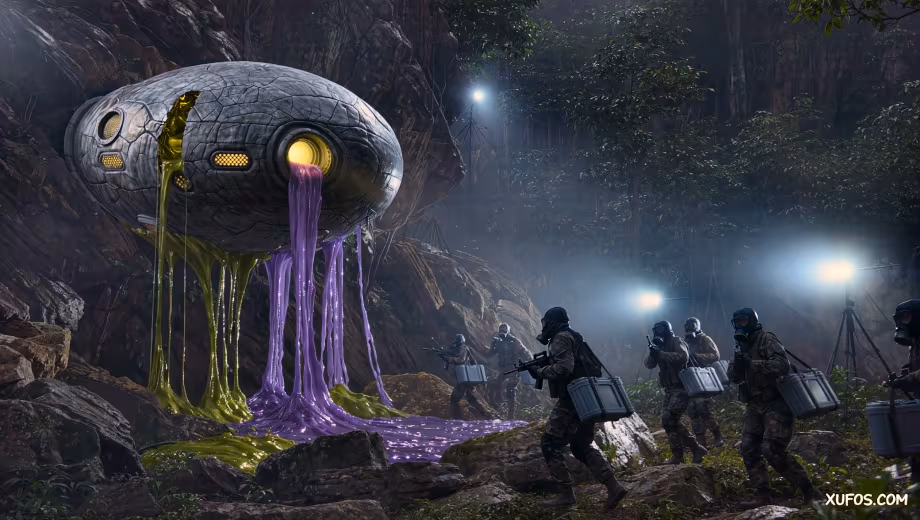
In March 1997, during Operation Laser Strike in the Peruvian jungle, USMC Lance Corporal Jonathan Weygandt was part of a Marine unit providing perimeter security for radar installations. Sent to investigate what was thought to be a downed friendly aircraft or drug-smuggling plane, he and his team instead discovered a large egg/teardrop-shaped craft wedged into a rocky cliff face, clearly not human-made, damaged by what appeared to be a HAWK missile strike.
The craft had an organic quality: strange purple-green viscous liquid dripping everywhere, no machined parts, vents that absorbed light instead of reflecting it, and an almost living presence. Soon after, an unmarked team in black camouflage (no insignia) and full MOPP gear (gas masks, rubber suits) arrived aggressively, took control, shackled Weygandt, interrogated him, threatened him with severe consequences if he ever spoke, and removed him from the site.
He later faced reprisals for discussing it with fellow Marines. This is one of the most powerful firsthand testimonies of a U.S. military UFO crash retrieval operation, complete with non-human craft, a hostile unmarked retrieval team, and lasting personal cost to the witness.
Timeline of Events – March/April 1997
Reconstructed from Jonathan Weygandt's 2000 Disclosure Project testimony, his 2023–2025 interviews (Podcast UFO, UAP Gerb), Operation Laser Strike records, and supporting research.
- March 1997 Jonathan Weygandt, Lance Corporal with USMC MACG-28 (Marine Air Control Group 28), deploys to Pucallpa, Peru as part of Operation Laser Strike, a classified USSOUTHCOM counter-narcotics mission. His role: low-altitude air defense gunner (Stinger MANPADS and Avenger SAM systems) providing perimeter security for radar installations tracking drug-smuggling aircraft.
- Incident day (exact date classified, March–April 1997) Weygandt and fellow Marines are tasked with securing what command believed was a downed friendly aircraft or drug plane in the jungle. They reach the site and discover a large egg/teardrop-shaped craft wedged into a rocky cliff face, obviously not human-made, damaged by what appeared to be a HAWK missile strike. Craft has strange organic-like properties: purple-green viscous liquid dripping everywhere, vents that absorb light, no machined parts, almost alive feel.
- Arrival of retrieval team Shortly after discovery, an unmarked team arrives aggressively, black camouflage, no insignia, full MOPP gear (gas masks, rubber suits). They immediately take control, shackle Weygandt and others, remove them from the site, interrogate harshly, and threaten severe consequences (prison, death, family harm) if they ever speak about it. Weygandt is thrown into mud, liquid gets on him, causing lasting health effects.
- Aftermath & reprisals Weygandt persists in discussing the incident with fellow Marines, leading to punishment and isolation. He keeps silent publicly for years but is deeply affected (health issues, PTSD-like symptoms). The craft and any beings/material are removed by the team (suspected Department of Energy or special black-project unit).
- May 2000 Weygandt gives testimony to Dr. Steven Greer for the Disclosure Project, one of the first public accounts of a firsthand crash retrieval by U.S. military personnel.
- 2023–2025 Weygandt speaks publicly again (Podcast UFO, UAP Gerb in-person interview), only his second major interview. He reaffirms every detail, adds new health impact revelations, and stresses Americans deserve to know the truth despite the reprisals he faced.
What Jonathan Weygandt Described
Jonathan's testimony is raw and consistent across 25 years. He describes the craft as huge, egg/teardrop-shaped, wedged in rocks, damaged by HAWK missile. Surface was not machined, organic-like, with purple-green viscous liquid dripping everywhere (like tree sap but surreal). Vents absorbed light instead of reflecting it. Craft felt "alive", not like human technology. No beings visible at first, but he sensed something non-human was involved.
"It was dripping this surplus-like liquid... purple-green color... everywhere. It was weird. It kind of seemed to be alive. It wasn't machined parts, it looked sculpted. The vents absorbed light, no reflection. It felt like something organic."
– Jonathan Weygandt (2000 Disclosure Project & 2025 interviews)
"They threw me into the mud... all that liquid got in my hair and my face. They were like scientists in MOPP gear, gas masks, rubber suits. All kinds of weird people, different kinds of protective gear. They shackled me, took me away, told me never to speak or bad things would happen."
– Jonathan Weygandt (describing the retrieval team)
"I'm still alive, that's the positive. But they made sure I paid for talking. I kept quiet for years. Now I want Americans to know this happened and it's covered up."
– Jonathan Weygandt (2023–2025 interviews)
"The craft was damaged, looked like a missile hit it. But it wasn't like any plane or helicopter. It had this organic feel, like it was partly alive. The liquid was sticky, glowing a little. I knew right away this wasn't ours."
– Jonathan Weygandt (2025 UAP Gerb interview)
"They treated us like we were the enemy. Shackled, questioned for hours. Told us if we talked, we'd disappear. I believed them. I still look over my shoulder sometimes."
– Jonathan Weygandt (reflecting on reprisals)
The retrieval team arrived fast, black camo, no patches/insignia, MOPP gear, gas masks, rubber suits. They were aggressive, professional, scientific-like. They shackled him, interrogated harshly, threatened lifelong consequences (prison, death, family harm) if he spoke. Liquid got on him during handling, later health issues (skin problems, fatigue, unexplained symptoms). He emphasizes the craft was not ours, not from Earth, and the cover-up was immediate and brutal.
The Operation Laser Strike Context
Jonathan was deployed with MACG-28 (Marine Air Control Group 28) from MCAS Cherry Point to Pucallpa, Peru, as part of Operation Laser Strike, a classified USSOUTHCOM counter-narcotics mission. His unit provided perimeter security for radar installations tracking drug-smuggling aircraft. Laser Strike involved up to 20 U.S. agencies (USMC, DEA, USAF, CIA, National Guard) and Peruvian forces. They tracked 45,000 aircraft in 1996–1997, forced down 21 suspected drug planes. Weygandt's team was sent to secure what command believed was a downed friendly aircraft or drug plane, instead they found the non-human craft.
The Retrieval Team & Reprisals
The team that arrived was unmarked, black camouflage, no insignia, full MOPP gear (gas masks, rubber suits). They were aggressive, professional, scientific-like. They shackled Weygandt, interrogated him harshly, threatened lifelong consequences (prison, death, family harm) if he spoke. He was thrown into mud/liquid, causing lasting health effects (skin issues, fatigue, unexplained symptoms). He later discussed it with fellow Marines and faced punishment/isolation. He kept silent publicly for years but felt compelled to speak in 2000 (Disclosure Project) and again in 2023–2025 to ensure Americans know the truth despite personal cost.
Lance Corporal Jonathan Weygandt – Peru UFO Crash Testimony

More videos of Jonathan Weygandt's testimony
Legacy in 2026
Over 25 years later, Jonathan Weygandt's testimony remains one of the strongest firsthand accounts of a U.S. military UFO crash retrieval. His raw emotion, consistency across decades, polygraph-level credibility (no public polygraph but Sheriff's tape-like authenticity), and the reprisals he faced all point to a real event. In 2026, with UAP disclosures accelerating, his story is revisited as powerful evidence of crash retrieval teams (possibly DOE-linked), non-human craft, and aggressive containment. No physical proof has been released publicly, but Jonathan's courage in speaking, despite the consequences, keeps the truth alive and inspires others to come forward.
