Quick Info
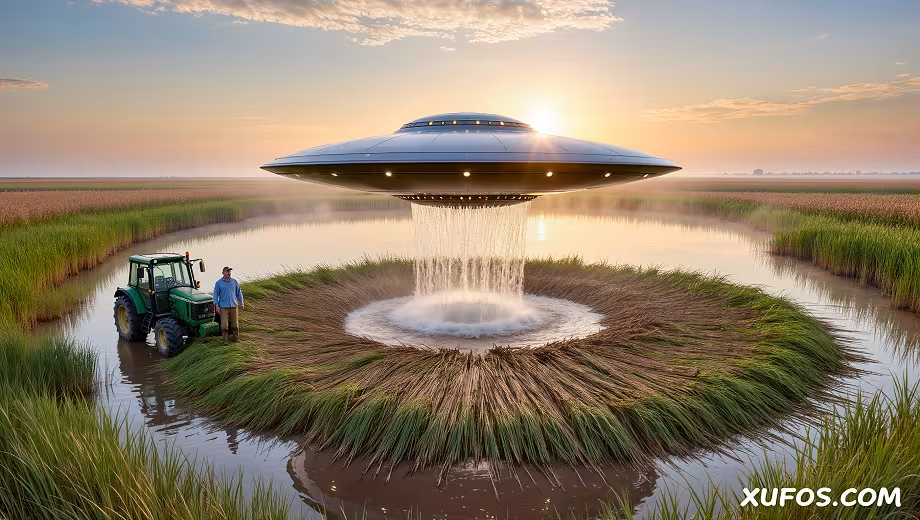
On January 19, 1966, sugarcane farmer George Pedley was driving his tractor near Tully, Queensland, when he saw a large saucer-shaped object rise from Horseshoe Lagoon with a loud hissing sound. It left behind a massive circular “nest” of flattened and swirled reeds. Similar nests appeared in the area over the following weeks. One of Australia’s most famous and best-documented physical trace UFO cases.
The Tully nests caused a sensation in 1966. Police, scientists, and journalists investigated the sites, and the reeds showed unusual cellular changes. The case remains a classic example of a close encounter leaving tangible physical evidence.
A Quiet Morning in Far North Queensland
Tully in 1966 was a small sugarcane farming town surrounded by lush wetlands and lagoons. George Pedley, a 27-year-old local farmer, was driving his tractor along a track beside Horseshoe Lagoon when something caught his eye. The morning was clear and still, perfect conditions for spotting anything unusual.
The Sighting
Pedley saw a large, dull-gray, saucer-shaped object about 25 feet across and 9 feet high rising rapidly from the lagoon. It made a loud hissing or whooshing sound and climbed at a steep angle before accelerating away at high speed. The whole event lasted only a few seconds.
“It was a saucer-shaped thing, dull gray in colour, and it rose up out of the water with a loud hissing noise.”
— George Pedley
After the object disappeared, Pedley drove over to the lagoon and discovered a large circular area where the reeds had been flattened and swirled in a clockwise direction, forming a perfect “nest” about 30 feet in diameter.
The Flying Saucer Nests
The nest was impressive. The reeds were bent over neatly in a radial pattern and showed no signs of being cut or burned. Within days, more similar nests appeared in nearby lagoons. Some were smaller, others larger, but all showed the same swirled, clockwise flattening. Locals began calling them “flying saucer nests.”
Scientific Analysis of the Nests
The Tully nests attracted immediate scientific attention. Police officers documented the sites with photographs and measurements, then sent samples to the University of Queensland and the CSIRO (Commonwealth Scientific and Industrial Research Organisation). Scientists found the reeds had been flattened in a precise radial, clockwise swirl pattern without any signs of burning, cutting, or animal damage. The stems appeared to have been subjected to sudden intense pressure or heat that softened the plant tissue just enough to bend it neatly into the circular shape.
Microscopic examination revealed unusual cellular changes. The internal structure of the reeds showed signs consistent with rapid heating or exposure to electromagnetic energy, yet there was no charring or scorching on the surface. Some reeds from the nests later exhibited accelerated growth compared to surrounding vegetation. The CSIRO team could not replicate the effect with any known natural cause such as wind, water currents, or human activity. Similar “saucer nests” appeared in nearby lagoons over the following weeks, all displaying the same swirled pattern and cellular anomalies.
“The reeds were bent with such force and precision that it was difficult to explain by any ordinary means.”
— CSIRO scientist involved in the examination
The combination of the physical traces, the eyewitness account, and the laboratory findings made the Tully case one of the strongest physical evidence events in Australian UFO history.
Timeline of the Tully Nests
- January 19, 1966 – Morning – George Pedley sees the saucer-shaped object rise from Horseshoe Lagoon.
- Immediately after – He discovers the first large circular nest in the reeds.
- Following days – Additional nests appear in nearby lagoons.
- January–February 1966 – Police and scientists investigate the sites and collect samples.
- 1966 onward – The Tully nests become one of Australia’s most discussed physical trace cases.
Why This Case Is Still Important
The Tully Flying Saucer Nests stand out because they left clear, measurable physical evidence that was examined by scientists. The precise circular patterns, the swirled reeds, and the unusual cellular changes could not be easily explained away. George Pedley was a respected local farmer with no interest in UFOs or publicity. His straightforward account, combined with the physical traces, makes this one of the strongest landing cases in Australian UFO history and a classic example of a close encounter leaving tangible proof behind.
Great video on this event from @EyesOnCinema on YouTube

More videos from @EyesOnCinema on YouTube
What Do You Think?
After reading about George Pedley’s sighting and the mysterious Tully nests, and watching the video above, what’s your reaction? Do you think the nests were left by a landed UFO, or could there be another explanation? Why do you think the reeds showed such unusual changes? The way the reeds themseleves were flattened without any damage at all is quite bizarre. This is one of Australia’s best physical trace cases, I’d love to hear your thoughts on it.
