Quick Info
November 14, 2004. Somewhere off the coast of Southern California. A routine training mission turns into one of the most credible, best-documented UAP encounters in modern history. This is not speculation or blurry photos. It is radar data, infrared footage, eyewitness testimony from elite Navy pilots, and official Pentagon confirmation. Two decades later, the Tic Tac still has no explanation...
The Lead-Up: Two Weeks of Radar Ghosts
The USS Nimitz Carrier Strike Group was conducting pre-deployment exercises about 100 miles southwest of San Diego. On board were some of the Navy’s most advanced assets. That included the nuclear supercarrier USS Nimitz, the Aegis cruiser USS Princeton, and Carrier Air Wing 11. The wing featured the brand-new F/A-18F Super Hornets of VFA-41 “Black Aces.”
For roughly two weeks before November 14, radar operators on the Princeton had been seeing strange things on their SPY-1 phased-array radar. Objects would appear at 80,000 feet, higher than almost any aircraft flies. Then they would drop straight down to sea level in less than a second. They would hover for hours, then shoot straight back up and disappear. No transponders. No radio communication. No visible propulsion. Sometimes as many as 10 to 20 at once.
Senior Chief Kevin Day, an experienced air-intercept controller, initially thought it was a software glitch or maybe classified test drones. But the contacts were consistent and repeatable. They were also physically impossible for any known technology. The operators started calling them “anomalous aerial vehicles” (AAVs) in their logs.
“These weren’t birds, balloons, or glitches. They were real, physical objects doing things we couldn’t explain.”
– Senior Chief Kevin Day (radar operator, USS Princeton)
November 14, 2004 – The Intercept
Around midday, the Princeton detected another group. This time they decided to send fighters. Not to shoot, but to look.
Two F/A-18F Super Hornets from VFA-41 were already airborne on a 2v2 training mission. Lead pilot: Commander David Fravor, commanding officer of the Black Aces and a TOPGUN graduate with thousands of hours. His wingman: Lt. Cmdr. Alex Dietrich. Both had weapons systems officers in the back seats.
The Princeton broke into their training frequency.
“Hey, we’re going to cancel the training. We’ve got a real-world vector.”
Fravor asked for loadout status, standard when things might get serious. He joked “cat-o’-nine” (training missiles only). The controller replied:
“We’ve seen these objects for two weeks. We need you to go investigate.”
They were vectored to a merge plot about 60 miles west. Clear skies, calm seas, perfect visibility.
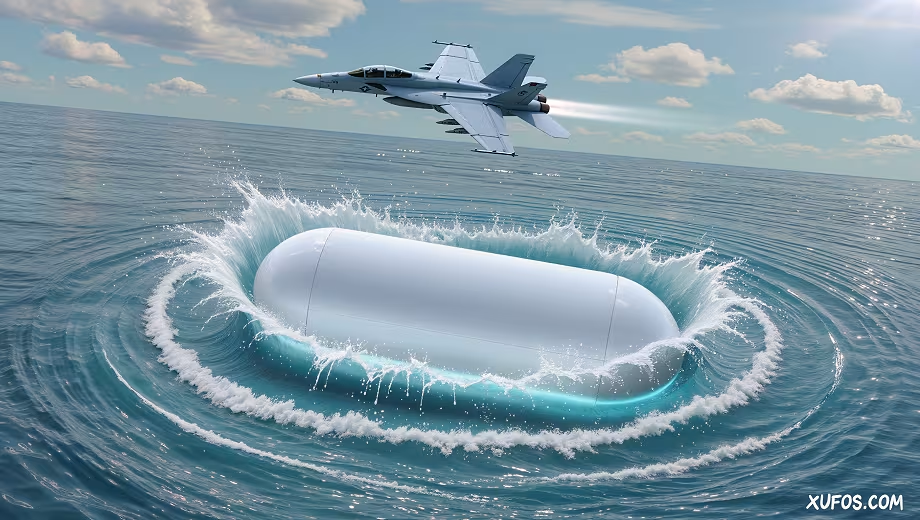
As they descended, they saw it: a large patch of churning white water on the ocean. It looked like something massive had just submerged or was disturbing the surface from below. No ship. No wake. No debris. Just boiling water the size of a Boeing 737.
Hovering right above it, at about 50 feet altitude: a smooth, solid-white, oblong object. No wings, no rotors, no markings, no seams. Roughly 40 to 46 feet long. Shaped exactly like a Tic Tac turned on its side. It was moving erratically. Not fast, but jittering, almost dancing in place.
Fravor said:
“It was unidentified. And that’s why it was so unsettling to us.”
Dietrich added:
“It had no predictable movement or trajectory. It was just kind of moving above the whitewater area.”
Fravor spiraled down for a closer look, a classic fighter move. Dietrich stayed high as cover. As Fravor closed to about half a mile, the object reacted. It aligned its long axis with his aircraft, began mirroring his turn, and climbed in a clockwise spiral. It perfectly matched his descent but in reverse.
Fravor pushed his nose onto it. The Tic Tac accelerated straight ahead at incredible speed and vanished. Fravor estimated it covered 60 miles in under a minute. No sonic boom. No exhaust. No wake. Gone.
The four crew members watched it for about five minutes. No radar lock. The object seemed to jam or evade their fire-control radars. Under normal circumstances this is an act of aggression.
Kevin Day and the Radar Evidence: The View from the Princeton
While Commander David Fravor and Lt. Cmdr. Alex Dietrich are the most visible faces of the Tic Tac encounter, the event actually began days earlier on the radar scopes of the USS Princeton. Senior Chief Kevin Day, the lead air-intercept controller and senior radar operator aboard the Princeton, was the first to notice something seriously wrong with the sky.
Day had spent his career operating some of the Navy’s most advanced systems, including the SPY-1 phased-array radar on Aegis cruisers. He was responsible for identifying every contact in the airspace around the carrier strike group. For nearly two weeks before November 14, his screens had been filling with strange returns.
These were not normal aircraft signatures. Day described objects appearing suddenly at altitudes above 80,000 feet, then dropping straight down to around 20,000 or even sea level in less than a second. They would loiter for hours, sometimes in groups of 10 to 20, then climb back to extreme altitude and vanish. No transponders. No radio communication. No predictable flight paths.
At first, Day and his team suspected a system glitch or test interference. They shut down and recalibrated the radar systems, including the new AN/SPY-1B passive mode and the Cooperative Engagement Capability (CEC) network. After recalibration, the tracks became sharper and clearer, not weaker. The objects were real.
Day later said:
“Watching them on the display was like watching snow fall from the sky.”
– Senior Chief Kevin Day (USS Princeton radar operator)
He estimated that over the course of the week, his radar had tracked well over 100 of these anomalous aerial vehicles (AAVs). They moved in loose clusters, tracked south along the training area, and showed performance no known aircraft could match. Day recalled one particularly striking detail: some objects appeared to be in low Earth orbit before dropping down to 80,000 feet.
When the Princeton vectored Fravor’s flight to investigate on November 14, Day was still actively tracking. He provided real-time updates to the pilots as they closed on the contact. During Fravor’s visual engagement, Day’s radar continued to follow the object. He watched it mirror the fighter’s movements, accelerate away, and disappear from scope.
Day has spoken publicly in interviews, including on the History Channel series Unidentified and various podcasts. He emphasizes that the radar data was solid and multi-sensor correlated. The Princeton’s Aegis system was feeding tracks to the entire strike group in real time. The objects were physical, trackable, and far beyond any known technology in 2004.
One of Day’s most chilling observations came from the sheer volume and behavior:
“A biological entity inside of that thing would have been crushed by the G-forces. We didn’t know what to think. It was so far beyond any of our experiences. We were dumbfounded is probably the best way to put it.”
– Senior Chief Kevin Day
After the incident, much of the radar data was collected and sent up the chain of command. Day has said he was never formally debriefed or asked to write a report. Like many others involved, he carried the experience quietly for years, dealing with the personal impact of witnessing something that challenged everything he knew about physics and aviation.
Day’s testimony remains one of the strongest pillars of evidence in the Tic Tac case. While the pilots saw the object visually, it was Day and his radar team who first detected it, tracked it for days, and confirmed its impossible performance long before any video existed.
The FLIR Video – Chad Underwood’s Capture
Another Black Aces pilot, Lt. Chad Underwood, launched shortly after. His jet had the AN/ASQ-228 ATFLIR targeting pod. He was told to look for what Fravor described.
Underwood acquired a radar contact about 30 miles away, tried single-target track, and immediately lost the lock. He described it as “jammed” or “spit the lock.”
He switched to FLIR and found the object visually on the pod. He hit record.
The now-famous 76-second “FLIR1” video shows a small, cold (low heat signature) oval against a cold sky. It appears to rotate or tumble slowly. At one point it accelerates left out of frame as the pod struggles to track. Underwood never saw it with the naked eye. Only through the pod.
He later said it was “solid white, smooth, no edges,” roughly 40 feet long. He named it “Tic Tac” after the candy. Partly inspired by a joke in the movie Airplane!.
Aftermath and Official Silence (2004–2017)
Back on the Nimitz, Fravor debriefed with intelligence officers. He drew sketches of the object and described its behavior. No formal investigation followed immediately. Some pilots were quietly told not to discuss it openly. The usual mix of ridicule risk and classification concerns applied.
The Princeton’s radar tapes and other data were reportedly collected and sent up the chain. Possibly to the Office of Naval Intelligence or higher. For 13 years, the incident stayed buried.
2017 – The Floodgates Open
In December 2017, The New York Times published a bombshell article. It revealed:
- The existence of the Advanced Aerospace Threat Identification Program (AATIP), a secretive Pentagon UAP study program (2007–2012) funded at 22 million dollars through Senator Harry Reid’s initiative.
- Three declassified Navy videos: FLIR (“Tic Tac”), GIMBAL, and GOFAST. All from 2004–2015 Navy encounters.
- Fravor and other pilots going public with detailed accounts.
The Pentagon confirmed the videos were genuine and unexplained.
Fravor’s 2021 60 Minutes interview with Bill Whitaker became one of the most watched UAP segments ever:
“It was white. It was smooth. No wings, no visible flight surfaces.”
– Cmdr. David Fravor
“It was just kind of moving above the whitewater area. No predictable movement or trajectory.”
– Lt. Cmdr. Alex Dietrich
“This thing had just traveled 60 miles in less than a minute. Far superior in performance to my brand-new F/A-18F.”
– Cmdr. David Fravor
So that means the object, whatever its origin, was going over 3,600MPH to cover that distance. Makes you think.
Performance That Defies Known Physics
From pilot testimony, radar logs, and leaked AATIP-related documents:
- Descent rate: 80,000 feet to sea level in less than 1 second. Average speed around Mach 90.
- Acceleration: Estimated more than 5,000 g. Human pilots black out at about 9 g.
- No heat signature on FLIR. No conventional jet or rocket propulsion.
- Apparent radar jamming or spoofing behavior.
- Transmedium capability? Some accounts suggest objects entered and exited water without splash.
Skeptical explanations (for example from Mick West and Metabunk):
- FLIR “acceleration” is camera zoom plus parallax artifact.
- Radar anomalies could be electronic warfare tests or glitches.
- Visual sighting possibly misidentified balloon or drone plus expectation bias.
Counterpoints:
- Multiple independent sensors (radar plus visual plus IR) corroborate.
- Pilots are highly trained observers. Not prone to hallucination.
- No known U.S. or foreign technology in 2004 matches the performance.
- Official DoD and AARO position (2021–2025): still unexplained.
Great Video on the Nimitz Encounters

Visit The Nimitz Encounters on YouTube
Why the Tic Tac Still Matters in 2026
Two decades after the event, the Nimitz Tic Tac remains the cornerstone of modern UAP discourse for several reasons:
- It triggered serious congressional interest (2021–2023 hearings, UAP Task Force, AARO).
- It shifted “UFO” from fringe conspiracy to legitimate national-security topic.
- It demonstrated multi-sensor, multi-witness military encounters that remain officially unexplained.
- It showed that even the world’s most powerful military can encounter something it cannot intercept or identify.
Cmdr. David Fravor has consistently said:
“Whatever it was, it was real. It was physical. And it was doing things that we don’t have technology for.”
Whether classified human breakthrough, foreign adversary leap, non-human intelligence, or something else entirely, the Tic Tac forced the world to ask one question. What is operating in our skies with impunity? And more importantly: Why hasn’t anyone in power given us a straight answer in twenty years?
Related Cases and Patterns
This encounter shares characteristics with later Navy videos (GIMBAL 2015, GOFAST 2015) and East Coast UAP swarms reported between 2014 and 2019.
