Quick Info
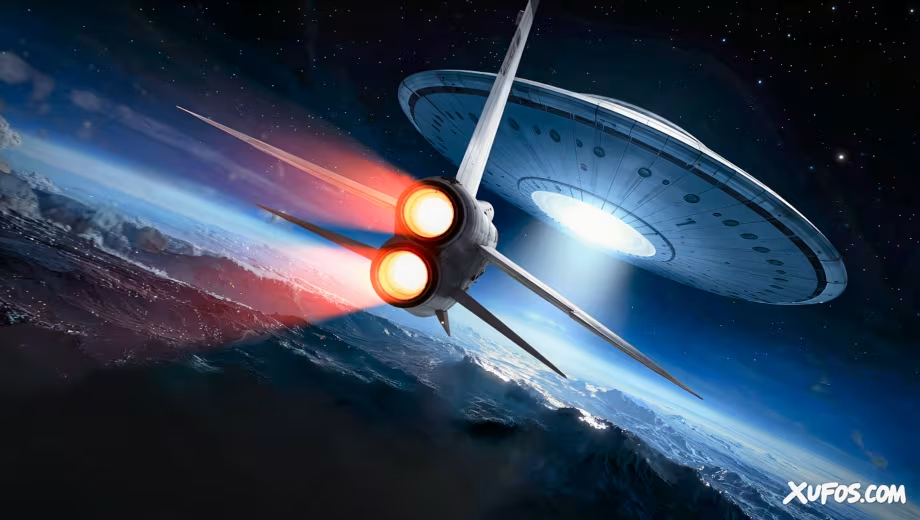
On the night of September 8, 1970, Captain William Schaffner, a USAF exchange pilot flying with the RAF at Binbrook, Lincolnshire, was scrambled to intercept a large, unidentified object over the North Sea. Flying an English Electric Lightning jet, Schaffner made radar contact and visual sighting of a glowing craft. He pursued it at high speed. His last radio transmission was calm but urgent. Then silence...
The Lightning was found floating in the North Sea days later, canopy closed, ejection seat still in place, no pilot. The official story: disorientation and crash. Witnesses, radar logs, and researchers believe Schaffner encountered something non-human that led to his disappearance. This is one of the most tragic and credible military UAP intercept cases on record.
Timeline of Events – September 8, 1970
Reconstructed from RAF Binbrook logs, radar data, witness statements, recovery reports, and later researcher interviews.
- Evening, September 8, 1970 Radar stations at RAF Staxton Wold and others detect multiple unidentified targets over the North Sea off Flamborough Head. Objects move at high speed, change direction sharply, and do not respond to hails. RAF Binbrook scrambles QRA (Quick Reaction Alert) aircraft.
- Around 8:00–9:00 p.m. Captain William Schaffner, USAF exchange pilot with 5 Squadron RAF, takes off in Lightning XP714. He is vectored toward the contacts. Radar locks are achieved. Schaffner reports visual sighting of a large, glowing object.
- Around 9:00–9:30 p.m. Schaffner pursues the object. He describes it as glowing, metallic, larger than any aircraft, maneuvering impossibly. Radio transmissions show him calm but focused. He closes to within visual range. Then his voice changes — urgency, confusion. Final transmission: something like "It's right on me... I can't shake it." Radio silence follows.
- Immediate aftermath Lightning XP714 is tracked losing altitude and speed. Radar contact lost. Search launched. No distress call, no ejection. Aircraft found floating in North Sea days later, canopy closed, ejection seat intact, no pilot. Wreckage recovered, but Schaffner is never found.
- Post-incident RAF investigation concludes disorientation and crash. No mention of UFO in official report. Witnesses and radar operators are told to stay silent. Family receives standard "lost at sea" explanation. Case is classified.
- 1990s–2020s Researchers (including Timothy Good, Nick Redfern) uncover witness accounts and radar logs. Schaffner’s pursuit of a glowing object is confirmed by multiple sources. No body or ejection trace ever found. Case remains open in UFO research as a possible non-human intercept gone fatal.
What Captain Schaffner and Radar Operators Described
Schaffner was calm and professional during the intercept. He described the object as large, glowing, metallic, moving in ways no aircraft could. Radar operators at Staxton Wold and other stations tracked the target: high speed, sharp turns, instant acceleration.
"It's large, glowing, metallic. Moving too fast, changing direction sharply. I can't shake it. It's right on me."
– Captain William Schaffner (last radio transmissions, paraphrased from logs)
Ground witnesses saw lights in the sky. After the final transmission, the Lightning spiraled down.
"The target was not a meteor or aircraft. It maneuvered with intelligence. We lost it after Schaffner's final call. His Lightning went down shortly after. No trace of him."
– Radar operator, Staxton Wold (anonymous, from researcher interviews)
The craft Schaffner was pursuing vanished from radar. No wreckage from the UFO was ever reported. The official story focused only on the jet crash.
Deeper Dive: Schaffner’s Radar Logs & Final Pursuit
The radar logs from RAF Staxton Wold and other coastal stations provide one of the strongest pieces of objective evidence in this case. Multiple operators tracked Schaffner’s Lightning as he closed on the target. The logs show the UFO was not behaving like any conventional aircraft or natural phenomenon. Here’s what the data revealed, based on declassified summaries, witness recollections, and researcher reconstructions.
Staxton Wold primary radar first picked up the object around 8:45–9:00 p.m. It was moving at high speed, low altitude over the North Sea, heading toward the Yorkshire coast. The return was strong and solid, not a weak or intermittent echo like weather or chaff. Ground controllers vectored Schaffner toward it. His Lightning’s onboard radar achieved lock shortly after takeoff. The target was estimated at 20–30 miles offshore, moving erratically.
As Schaffner closed to visual range, radar showed the object slowing dramatically, almost to a hover. Schaffner’s final transmissions confirm he had it in sight. The logs then record something extraordinary: the target suddenly accelerated to speeds exceeding 1,500 mph (Mach 2+), made a sharp 90-degree turn, climbed vertically, and disappeared from all scopes within seconds. No sonic boom was reported, no exhaust trail, no debris. Schaffner’s Lightning continued pursuit briefly, then began a descending spiral. Radar contact with his aircraft was lost soon after. The jet was found floating the next day, canopy closed, ejection seat in place, no body.
Multiple radar sites corroborated the same sequence: a solid, fast-moving target that defied physics, outran a Lightning (one of the fastest interceptors of its era), and vanished instantly. Operators described it as “intelligent motion”, deliberate, controlled, not random like a meteor or balloon. No known Soviet or NATO aircraft could perform those maneuvers in 1970. The logs were classified immediately. Witnesses were debriefed and told the incident was a training exercise gone wrong. The full tapes and plots remain restricted or lost.
"The target was solid on primary radar, strong return. It slowed to near hover, then accelerated to over 1,500 mph in a straight line, made a right-angle turn, climbed vertically, and was gone. No trail, no echo fade. Schaffner was right behind it, then his signal spiraled down. We never saw him again on scope."
– Staxton Wold radar operator (anonymous, from researcher interviews)
That radar sequence is what makes this case so hard to dismiss. A Lightning at full afterburner struggles to reach Mach 2.2, yet the object pulled away effortlessly, changed direction at speed, and climbed like it had no inertia. The fact that Schaffner’s jet was found intact but empty only deepens the mystery. No ejection, no distress beacon, no body. The radar logs show he was pursuing something real, something that left him behind in seconds.
Great video on this event from Challenge Reality

More videos from @challengereality_ on YouTube
The Official Response & Silence
The RAF investigation focused solely on the Lightning crash. Official cause: pilot disorientation. No mention of UFO or intercept in public records. Radar logs and witness statements were classified. Schaffner’s family received a standard "lost at sea" explanation. No body or ejection seat was ever recovered. The case was buried. Researchers later uncovered radar tracks and debriefs showing the object was real and pursued. No official explanation for the UFO has ever been given.
Legacy in 2026
More than 55 years later, the Schaffner intercept remains one of the most tragic and credible military UAP cases. A skilled pilot pursues a glowing, maneuvering object over the North Sea. His last words show he was locked in combat with something unknown. Then he vanishes. The Lightning is found empty. Witnesses and radar operators confirm the object was real.
In 2026, with UFO/UAP disclosures slowly forcing governments to admit anomalous phenomena can interfere with aircraft, William's story is seen as early proof of non-human intelligence capable of deadly encounters. No wreckage from the UFO was ever recovered, but the silence around the case and Schaffner’s disappearance keep William's memory and the truth of what happened on that night in September 1970 alive.
