Quick Info
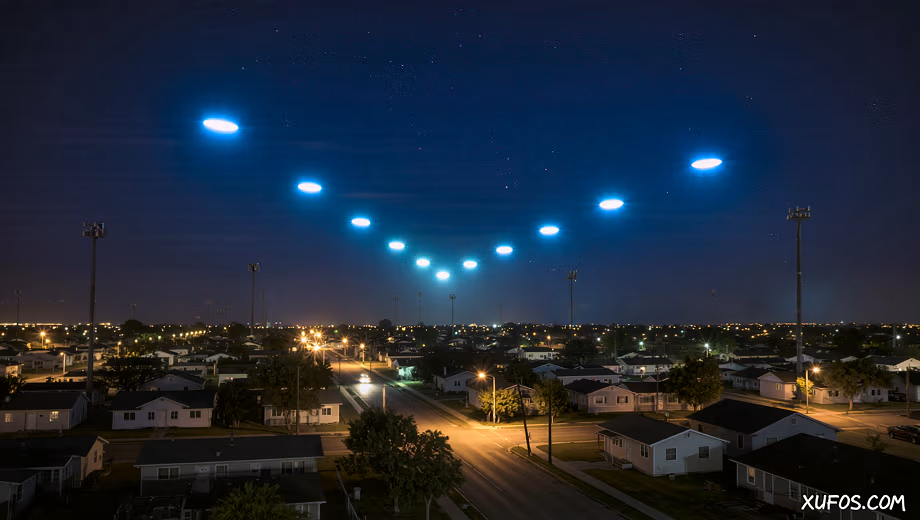
In August and September 1951, people in Lubbock, Texas, started seeing strange formations of lights moving across the night sky. It kicked off on August 25 when three Texas Tech professors (a geologist, a chemical engineer, and a petroleum engineer) were sitting in a backyard and watched 20-30 bluish-green lights fly over in a U-shape or arc. They saw the lights multiple times over the next few weeks. Then on August 30, a Texas Tech freshman named Carl Hart Jr. managed to snap five photos of a V-shaped group of 18-20 white lights passing overhead.
Those pictures ended up in newspapers across the country and even Life magazine. Hundreds of locals reported similar sightings, describing the lights as silent, fast, larger than stars, and moving in perfect formation. The U.S. Air Force's Project Blue Book investigated, led by Captain Edward Ruppelt. He interviewed witnesses and had Wright-Patterson analyze the photos, concluding they were "never proven to be a hoax, but neither were they proven to be genuine."
The professors said the photos didn't quite match what they saw (V vs U shape). Ruppelt eventually suggested a "commonplace and easily explainable natural phenomenon," but kept the exact cause vague at first, later pointing to night-flying moths reflecting mercury-vapor streetlights. That explanation didn't convince everyone, especially given the speed, silence, and formation. The case became one of the most talked-about flaps of the early 1950s UFO wave.
Timeline of Events – August-September 1951
Here's how the event played out, based on eyewitness reports, newspaper accounts, Carl Hart's photos, and Edward Ruppelt's Project Blue Book investigation.
- August 25, 1951, around 9:00 p.m. Three Texas Tech professors (W.I. Robinson geologist, A.G. Oberg chemical engineer, W.L. Ducker petroleum engineering head) are sitting in a backyard chatting. They spot 20-30 soft, glowing bluish-green lights moving overhead in a U-shaped or arc formation. The lights are bright (brighter than stars but not blinding), silent, and travel fast. They disappear over the house. A short while later, another group appears. The professors are baffled; they rule out meteors or aircraft right away.
- Late August to early September The lights keep showing up. The professors see them at least ten more times. Other locals report similar formations: silent, fast-moving groups of lights in V or U shapes. Some describe them as larger than stars, moving in perfect coordination.
- August 30, 1951, evening Carl Hart Jr., a 19-year-old Texas Tech freshman, is in bed looking out his window when he sees a formation of 18-20 white lights in a V-shape fly over. He grabs his Kodak 35mm camera, sets it to f/3.5 and 1/10 second, goes to the backyard, and waits. The lights come back twice. He snaps five photos: two of one pass, three of another. He develops them himself, takes them to the Lubbock Avalanche-Journal. Editor Jay Harris buys them for $10 but warns Hart he'll be run out of town if they're fake. The photos hit local papers, then go national, including Life magazine.
- Late September 1951 Captain Edward Ruppelt, head of Project Blue Book, learns about the sightings and heads to Lubbock. He interviews the professors, Carl Hart, and other witnesses. He examines the photos at Wright-Patterson Air Force Base. After analysis, he tells the press the photos are "never proven to be a hoax, but neither were they proven to be genuine." The professors point out the photos show a V-formation, while they remember a U-shape.
- Later Project Blue Book assessment Ruppelt calls the professors' sightings "a very commonplace and easily explainable natural phenomenon" but won't name it publicly at first to protect the source who figured it out. In a later edition of his 1956 book The Report on Unidentified Flying Objects, he identifies it as night-flying moths reflecting light from new mercury-vapor streetlights installed in Lubbock. Some sightings remain "unknowns" in Blue Book files.
The Sightings and Carl Hart's Photos
The professors were credible witnesses: scientists with technical backgrounds who immediately dismissed stars, meteors, and planes. They described the lights as soft bluish-green, silent, moving fast in formation, and larger than stars. Other locals reported the same over weeks. Carl Hart's five photos are the only visual evidence: black-and-white shots showing dim, circular lights in a V-shape against the night sky.
"The lights went over so fast... that we wished we could have had a better look."
– One of the Texas Tech professors (via Ruppelt interviews)
He used a basic Kodak 35mm camera with short exposure. The images were analyzed extensively; Wright-Patterson found no tampering. Ruppelt's statement left them in limbo: not proven fake, not proven real. The professors noted the formation mismatch (U vs V) and said the photos didn't capture the exact look they remembered.
The Lubbock Lights from the great Richard Dolan

Visit Richard Dolan on YouTube
The Explanations and the Debate
Ruppelt's final take: the professors' sightings were moths (or plover birds) reflecting new mercury-vapor streetlights installed in Lubbock. The lights matched migration patterns for some birds, and tests showed birds could reflect light in formation. But critics point out the lights moved too fast and silently for birds or moths, and the formation was too precise. No radar confirmation for the main events (though related radar hits occurred elsewhere).
"The [Hart] photos were never proven to be a hoax, but neither were they proven to be genuine."
– Captain Edward J. Ruppelt, Project Blue Book (1951 statement)
The photos remain ambiguous: not hoaxed, but not definitively UFOs. Some suggested secret aircraft or atmospheric effects. The case is officially "explained" by Blue Book, but many feel Ruppelt's explanation was vague and didn't fully address witness contradictions.
Legacy in 2026
75 years later, the Lubbock Lights are still one of the classic 1950s UFO flaps: credible witnesses (professors, amateur photographer), published photos, national attention, and a Project Blue Book investigation that ended with a natural explanation not everyone buys. Featured in books (Ruppelt's Report), documentaries, and even dramatized on Project Blue Book TV series.
In today's UAP discussions, people revisit it for the multi-witness, photographic element and the "unknowns" that lingered in files. Was it just birds/moths/lights? Or something more exotic? The debate continues on X and in UFO circles, especially with renewed government interest in aerial phenomena.
