Quick Info
In December 1984 scientists on the remote Kola Peninsula in the Murmansk region of Russia detected a powerful seismic shock near the surface. Months later a military officer driving a caterpillar vehicle through the frozen tundra discovered a long trench and a heavily deformed metallic object.
The incident became one of the most intriguing alleged UFO crash retrieval cases from the final years of the Soviet Union. None of the available reports list a name for the military officer, sorry about that. Researchers such as Vadim Chernobrov and Maksim Karpenko claimed they personally met this officer and received metal samples from him, but neither Vadim or Maksim have ever publicly released his name.
The Seismic Shock
It was a cold December day in the far north of Russia, well above the Arctic Circle. Seismologists monitoring equipment on the Kola Peninsula recorded a strong shock wave with its epicenter located very close to the surface. At first they assumed it was a meteorite impact or perhaps a Soviet missile test from the nearby Plesetsk Cosmodrome. The event did not cause immediate alarm because such readings were not uncommon in the region.
The Discovery in the Tundra
Several months later, a local military officer was driving a heavy caterpillar vehicle through a remote and deserted stretch of tundra approximately 70 to 100 kilometers southwest of the Gemikha nuclear submarine naval base. What he stumbled upon left him stunned.
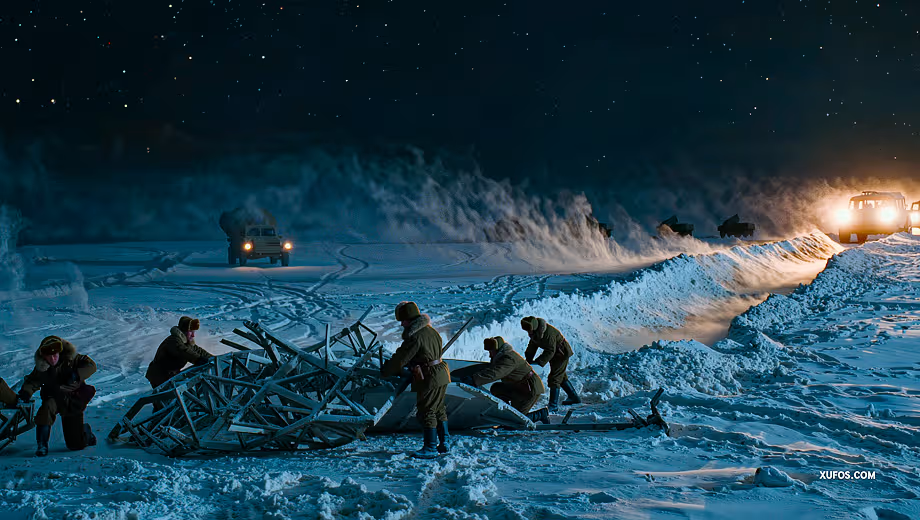
There was a long, impressive trench gouged into the frozen ground, roughly 50 meters in length. At the end of the trench lay a strange, heavily deformed mass of metal that had clearly impacted at extremely high speed.
“The object was deformed into an unrecognizable mass of metal as a result of the very strong impact.”
- Military officer witness
The officer estimated the wreckage weighed around five tons. He took samples of the unusual metal and brought them back to his base. Some fragments reportedly ended up in civilian hands, including researchers connected to Soviet UFO study groups.
The Object and Recovery
According to accounts from Russian UFO researchers, the original object was disc or dome-shaped, roughly 6 to 10 meters in diameter before the crash. The tremendous force of the impact had melted and charred much of the structure. Some reports suggest it was a piloted craft and that the crew may have been humanoid, though no intact bodies were ever publicly confirmed. The wreckage was reportedly transported to a secure military facility near Monchegorsk for further study.
Theories and Speculation
The official Soviet explanation leaned toward a meteorite or a failed missile stage. However, many researchers believe it was an authentic extraterrestrial craft, possibly shot down during some kind of aerial conflict.
The remote location, the seismic reading, the long impact trench, and the unusual metal fragments all contributed to the legend that something truly extraordinary crashed on the Kola Peninsula that winter.
Timeline of the Kola Peninsula Incident
- December 1984 - Scientists detect a powerful near-surface seismic shock on the Kola Peninsula.
- Months Later - Military officer discovers long trench and deformed metallic object in the tundra.
- Recovery - Wreckage reportedly taken to a secure base near Monchegorsk.
- Following Years - Story circulates among Russian UFO researchers.
Watch Discussions and Documentaries

More videos and discussions about this case on YouTube
What Do You Think?
A powerful seismic event in the remote Arctic tundra, followed by the discovery of a long impact trench and a heavily deformed metallic object. Was this simply a meteorite or a failed Soviet missile, or did something far more extraordinary crash on the Kola Peninsula that winter?
The combination of official seismic data, a military witness, and unusual metal fragments keeps this 1984 Russian case alive in UFO research circles. Seems like it wouldn't be a missile as nobody from the military came to look for it before the military officer located the wreckage, right? Let me know your thoughts on this case.
