Quick Info
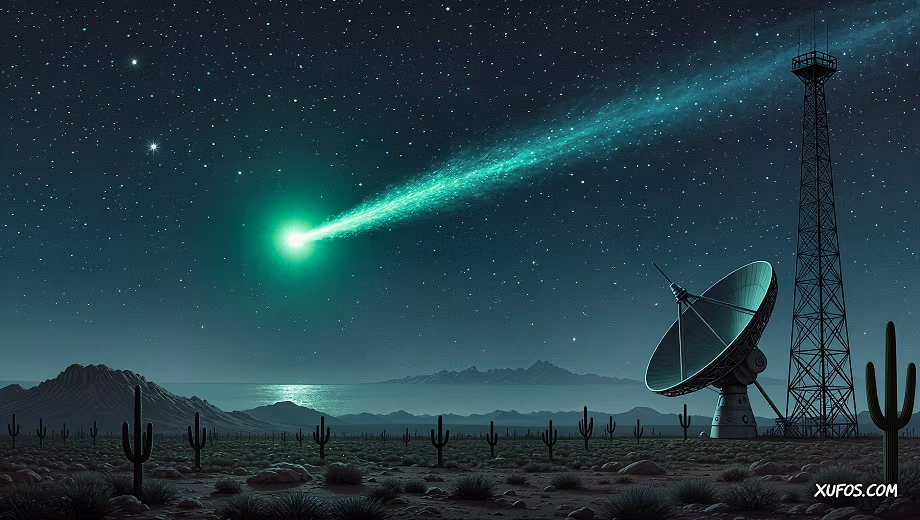
From late 1948 through early 1951, the skies over New Mexico lit up with something extraordinary: brilliant emerald-green fireballs that moved in ways no meteor or aircraft ever could. They appeared silently, changed direction sharply, hovered, accelerated instantly, and sometimes split or reversed course. Hundreds of people saw them, scientists at Los Alamos, radar operators at Sandia Base, pilots, military personnel, and ordinary citizens.
The objects were tracked on radar multiple times, chased by fighter jets, and photographed (though most images were classified or lost). The U.S. Air Force launched Project Twinkle to investigate, but the project was underfunded, short-lived, and never gave a satisfying answer. Witnesses described these green fireballs as larger than normal meteors, slower in some cases, faster in others, and clearly under intelligent control.
This was happening right over the most sensitive nuclear facilities in the world such as Los Alamos, Sandia, White Sands Proving Ground, during the height of the early atomic age. The timing feels too precise to be random. These weren't just lights in the sky; they were something watching, probing, and moving with purpose.
Timeline of the Green Fireball Wave – 1948–1951
Reconstructed from Project Twinkle files, declassified Air Force reports, witness interviews, Los Alamos scientific logs, and newspaper accounts of the period.
- Late November 1948 First major wave begins. Green fireballs appear over Los Alamos and Sandia Base. Scientists and security personnel report silent, emerald-green objects moving horizontally at high speed, changing direction sharply, sometimes hovering. Radar operators pick up targets that do not match known aircraft or meteors.
- December 5–12, 1948 Multiple sightings over Albuquerque and Kirtland AFB. Fireballs described as brilliant green, larger than typical meteors, leaving no smoke trails, moving in straight lines or gentle arcs, then suddenly accelerating or reversing. Pilots and ground observers note the color is distinct, not the usual orange or white of meteors.
- February 1949 Peak of the wave. Green fireballs seen almost nightly. One passes directly over Los Alamos at low altitude, silent, glowing intensely. Radar tracks object at speeds up to 1,000 mph, then sudden stops and direction changes. Air Force launches Project Twinkle, a small, underfunded effort to photograph and track the phenomena.
- 1949–1950 Project Twinkle deploys cameras, spectrographs, and radar teams at Sandia, White Sands, and other sites. They capture a few images and spectra showing unusual green emission lines (copper or barium?). Fireballs continue, some split into multiple objects, some hover for minutes, some dive vertically then pull up sharply. Witnesses include top nuclear scientists who rule out meteors and conventional aircraft.
- Early 1951 Sightings taper off. Project Twinkle ends with no conclusive explanation. Official report calls them “natural phenomena” but admits many cases remain unexplained. Radar and visual data show intelligent control in several instances. No public release of full findings until declassification decades later.
What the Witnesses Saw
The green fireballs were not subtle. They were brilliant emerald-green, larger than typical meteors, often described as 10–30 times brighter than Venus. They moved horizontally or in gentle arcs, sometimes hovered, changed direction sharply, accelerated instantly, or split into smaller lights. No sound, no smoke trails, no fragmentation like meteors. Radar tracked them at speeds from 300 to over 1,000 mph, with sudden stops and reversals. Scientists at Los Alamos and Sandia (people who built the atomic bomb) watched them repeatedly and ruled out known explanations.
"It was a brilliant green fireball, much larger and brighter than any meteor I had ever seen. It moved horizontally, then stopped, reversed direction, and accelerated away. No sound, no trail. It was under intelligent control."
– Los Alamos scientist (anonymous, from Project Twinkle files)
"The object was green, glowing, silent, and moved in ways no aircraft or meteor could. It hovered for several seconds, then shot upward at incredible speed. We watched it from the radar shack, the scope showed it stop and start instantly."
– Radar operator, Sandia Base (declassified testimony)
"These green fireballs appeared almost every night for weeks. They were not random. They followed patterns, came back to the same areas, moved with purpose. We knew they were something real and unknown."
– Kirtland AFB personnel (collective account from 1949 reports)
Pilots chased them and reported they outmaneuvered anything in the air. Ground observers saw them pass low over buildings and roads, lighting up the desert like daylight for seconds. The color was unique, pure green, almost electric, unlike any meteor or flare.
The Green Fireballs of 1948–1951 & Project Twinkle – Full Story

More videos on the Green Fireballs & Project Twinkle
Project Twinkle, The Official Hunt
The Air Force launched Project Twinkle in early 1949 to investigate the green fireballs. It was small, underfunded, and short-lived (ended 1951). Teams set up cameras, spectrographs, and radar at Sandia, White Sands, and Los Alamos. They captured a few images and spectra showing unusual green emission lines (copper or barium?), but most events were too fast or too high for good data.
Twinkle reports admitted many cases showed intelligent control, sharp turns, hovering, sudden acceleration, but concluded “natural phenomena” without naming a specific cause. Full files remained classified for decades; declassified portions show frustration among scientists who saw the objects repeatedly and could not explain them conventionally.
Why Over Nuclear Sites?
The timing and location are too precise to ignore. Los Alamos (atomic bomb development), Sandia Base (weapons assembly), White Sands (rocket and nuclear tests), the green fireballs appeared almost exclusively over these facilities. They hovered, circled, dived low, and returned multiple times. Scientists who built the bomb watched them and said they were not meteors, not aircraft, not flares.
Radar tracked them doing things impossible for known technology. The objects seemed to be probing, mapping, or monitoring the very heart of America’s nuclear program. In 1948–1951 the U.S. was racing to build its atomic arsenal, and something was watching closely.
Legacy in 2026
More than 75 years later, the Green Fireballs and Project Twinkle remain one of the strongest early waves of unexplained aerial phenomena. Hundreds of credible witnesses, nuclear scientists, radar operators, pilots, military personnel, saw the same thing night after night. Radar confirmed intelligent motion. Cameras caught glimpses. Project Twinkle ended without answers. The objects were real, they were not ours, and they focused on the most sensitive nuclear sites in the world.
In 2026, with UFO/UAP hearings forcing governments to admit anomalous phenomena are real, the Green Fireballs feel like the first chapter of the modern story. They were here, they were watching, and they left no doubt that something intelligent was operating in our skies during the birth of the atomic age.
