Quick Info
Late 2014 through 2015. Off the Virginia coast and Florida training ranges. Navy F/A-18 pilots from Carrier Air Wing 1 aboard USS Theodore Roosevelt reported near-daily encounters with unidentified objects. Radar from the USS Roosevelt and other ships tracked groups of objects descending from high altitude at extreme speeds. Pilots described seeing objects that looked like a "cube inside a clear sphere," rotating against the wind, accelerating instantly, and showing no heat signature or wings. The declassified GIMBAL and GOFAST videos captured some of these events on FLIR pods.
Radar Spikes and Training Disruptions
Starting in autumn 2014, the USS Theodore Roosevelt Carrier Strike Group upgraded its radar systems during a refit. Almost immediately, operators began detecting unusual contacts: clusters of objects appearing at 30,000+ feet, sometimes dropping to sea level in seconds, hovering, or flying at hypersonic speeds without sonic booms.
Lt. Ryan Graves (F/A-18 pilot) reported these incidents happened "almost daily" for months. Objects would appear on radar, jam or spoof systems, and sometimes merge or split. Pilots were briefed to treat them as potential safety hazards but were told not to discuss publicly.
"These things would be out there all day. We saw them so frequently that pilots began to alter training missions to avoid them."
– Lt. Ryan Graves (interview, 2019–2023)
Visual Encounters: The Cube-in-Sphere
Multiple pilots visually acquired the objects during daylight intercepts. Graves described one as a dark gray or black cube completely stationary inside a clear sphere, appearing to rotate independently while the outer sphere remained fixed. No visible propulsion, exhaust, or control surfaces. The object maintained position against high winds.
Other reports included orbs, Tic Tac-like shapes, and objects mimicking aircraft behavior before accelerating away. No collisions occurred, but pilots expressed concern over mid-air risks during busy training airspace.
The Declassified Videos: GIMBAL and GOFAST
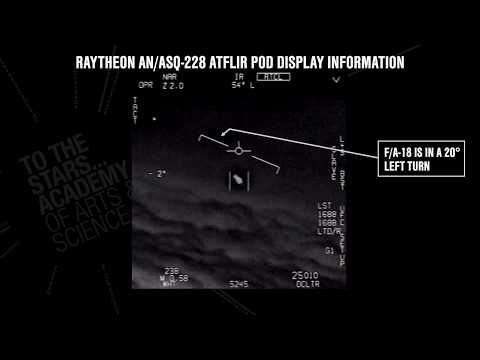
In 2017, The New York Times published three videos leaked from the Pentagon's AATIP program: FLIR (Nimitz), GIMBAL, and GOFAST. GIMBAL (2015) shows an object rotating steadily while pilots discuss its lack of wings or infrared plume. GOFAST (2015) captures a small, fast-moving object skimming over the ocean at high speed relative to the jet.
The Pentagon officially released the videos in 2020, confirming authenticity and labeling them "unidentified aerial phenomena." Analysis shows no conventional explanation fully accounts for the observed flight dynamics.
Key Videos from the Encounters
Official DoD / Navy channels for declassified clips
Official Responses and Ongoing Debate
The 2021 ODNI Preliminary Assessment on UAP referenced these East Coast incidents among 144 cases (2004–2021), noting unusual flight characteristics in some. AARO's later reports (2023–2025) attributed many to mundane objects (drones, balloons, sensor artifacts) but left a subset unexplained.
Pilots like Graves testified in congressional hearings (2022–2023), calling for better reporting and de-stigmatization. Critics argue optical illusions, classified tech, or foreign drones explain much; believers point to multi-sensor corroboration and physics-defying performance.
"This is a safety and national security issue. We need to know what we're dealing with."
– Lt. Ryan Graves (House UAP hearing)
Why These Encounters Matter in 2026
The Roosevelt incidents bridged Nimitz (2004) to modern UAP disclosure efforts. They showed repeated, prolonged exposure in restricted military airspace, forced policy changes (new Navy reporting guidelines in 2019), and fueled calls for transparency. Whether breakthrough tech, adversary drones, or something else, they underscore that unidentified phenomena in training areas pose real risks.
