Quick Info
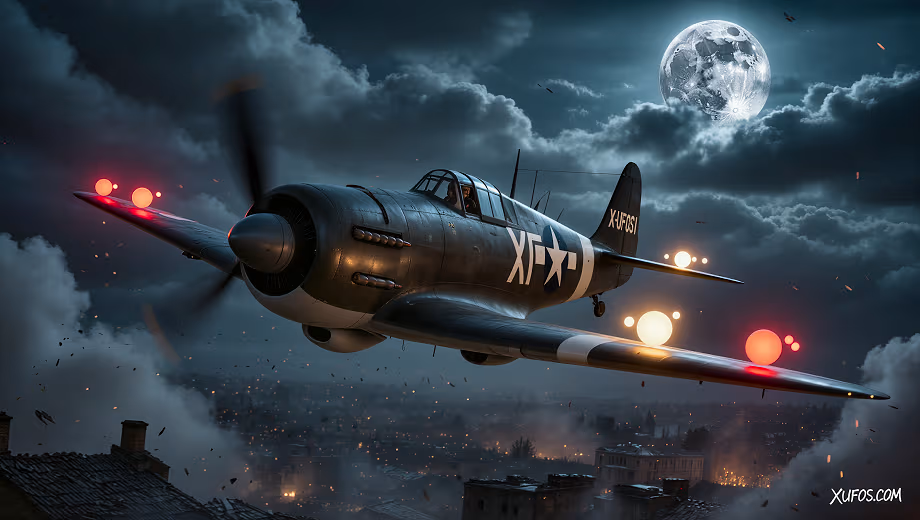
From late 1944 through the end of World War II in 1945, Allied and Axis pilots across both the European and Pacific theaters kept encountering the same mysterious glowing orbs. They called them Foo Fighters, red, orange, white, sometimes green, silent, intelligent lights that paced their aircraft, danced in formation, accelerated instantly, hovered, split apart, merged back together, and vanished without trace.
These were not flares, not ball lightning, not reflections as they were seen by hundreds of trained combat pilots, gunners, and navigators who knew every known aerial phenomenon. The orbs showed no hostility, never attacked, but they followed planes for minutes or even hours, often matching speed and maneuvers perfectly.
The name “Foo Fighters” came from the 415th Night Fighter Squadron in Europe, a playful nod to a comic strip catchphrase, but the encounters were deadly serious. No wreckage was ever recovered, no pilot was ever harmed by them, yet the objects clearly exhibited intelligent control. They appeared over battle zones, near airfields, above convoys, always watching, always present.
The phenomenon was so widespread that by early 1945 it was openly discussed in military briefings and newspapers. These were not illusions. They were real, and they were not ours.
Timeline of the Foo Fighter Sightings – 1944–1945
Reconstructed from declassified military reports, pilot debriefs, squadron logs, newspaper articles, and post-war interviews.
- Late 1944 – European Theater First widespread reports emerge from Allied night fighter and bomber crews over Germany. Pilots describe glowing orbs (red, orange, white) pacing their aircraft at close range, sometimes 50–200 feet away, matching speed and direction, then suddenly accelerating away or vanishing. 415th Night Fighter Squadron (P-61 Black Widows) coins the term “Foo Fighters” after a Smokey Stover comic strip line (“Where there’s foo, there’s fire”).
- November–December 1944 Sightings increase dramatically. Orbs appear in groups of 2–10, sometimes forming triangles or lines. Pilots report no sound, no exhaust, no wings, just glowing spheres that “dance” around planes, dart in and out of clouds, and seem to observe without attacking. Some crews fire on them, rounds pass through harmlessly or the objects simply move out of range.
- Early 1945 – Peak wave Foo Fighters seen almost nightly by Allied and German pilots. Luftwaffe crews report identical orbs over Reich territory, they called them “Feuerbälle” (fireballs). Objects follow bombers during raids, hover over airfields, pace fighters during dogfights. Radar sometimes picks up returns, but often the orbs are invisible to radar while visible to the eye.
- Mid-1945 – Pacific Theater Phenomenon spreads to Pacific. U.S. Navy pilots and B-29 crews report glowing orbs pacing formations over Japan, sometimes splitting and merging, sometimes diving into the sea or rising vertically at high speed. No hostile action, but crews are unnerved, some thought they were Japanese secret weapons.
- Post-war 1945–1946 Sightings taper off as the war ends. Military intelligence collects hundreds of reports but classifies most. Pilots are told not to discuss publicly. Some debriefings mention “foo fighters” as possible enemy devices, but no evidence ever links them to Axis technology.
Pilots, hundreds perhaps thousands of them, all seen these objects, and yet for some reason they weren't taken seriously. And they weren't restricted to one area, they appeared all over the world in every active combat zone. The high up Military didn't seem to care though, how does that make sense?
What the Pilots Actually Saw
Pilot accounts are remarkably consistent across squadrons, theaters, and nationalities. The orbs were typically 1–3 feet in diameter (sometimes larger), glowing red, orange, white, or green, completely silent, no visible structure or exhaust. They paced aircraft at close range (50–500 feet), matched speed and direction perfectly, then performed maneuvers impossible for known aircraft: instant acceleration to thousands of mph, right-angle turns, vertical climbs/descents, splitting into smaller lights, merging back together, hovering motionless, or simply vanishing.
"They were round, glowing, no wings, no sound. They paced us for miles, then one shot straight up and vanished. We fired everything we had, nothing touched them. They weren’t ours, and they weren’t Jerry’s either."
– 415th Night Fighter Squadron pilot (1944 debrief)
"The foo fighter came in close, bright orange, hovering off our wing. It followed every turn we made, then split into three smaller lights that danced around us before merging back and disappearing."
– B-17 crew member (1945 mission report)
"It was green this time, larger than usual. It paced us for ten minutes, silent, then shot forward at incredible speed and was gone. Radar had it for a second, then nothing. We knew it wasn’t a meteor or flare."
– P-51 Mustang pilot (late 1944)
They never fired weapons or attacked, they observed. Crews fired on them repeatedly, machine guns, cannons, with no effect; rounds passed through or the objects dodged effortlessly. Radar returns were sporadic, sometimes strong, sometimes invisible while visible to the eye. The behavior was clearly intelligent, they reacted to aircraft movements, followed formations, and seemed to study the planes. Many time Piolots said they even seemed "playful", which makes them even more bizarre.
Great video detailing the Foo Fighters mystery from Wartime Stories

More videos from Wartime Stories
The Official Response & Project Twinkle
During the war, Allied intelligence initially thought the Foo Fighters might be German secret weapons (Kugelblitz or Feuerball devices). German pilots reported the same orbs, so both sides were confused. After the war, the U.S. Air Force collected hundreds of reports but classified most. By 1948–1951, when green fireballs appeared over New Mexico nuclear sites, Project Twinkle was launched, a small effort with cameras, spectrographs, and radar.
Project Twinkle captured limited data: unusual green spectra (possible copper/barium), radar tracks of intelligent motion, but no conclusive explanation. Full files stayed classified for decades; declassified portions show scientists and military personnel were baffled and frustrated. The phenomenon was real, widespread, and not ours, yet no official answer was ever given.
Legacy in 2026
More than 80 years later, the Foo Fighters remain one of the clearest mass-witness UAP events in history. Hundreds of combat pilots, Allied and Axis, saw the same intelligent glowing orbs night after night, pacing aircraft, dancing in formation, accelerating impossibly, vanishing without trace. They never attacked, never crashed, never left debris, they simply watched.
In 2026, with UAP disclosures forcing governments to admit anomalous aerial phenomena are real, the Foo Fighters feel like the opening chapter of the modern story. They were here during the most destructive war in history, observing both sides, and they left no doubt that something intelligent was sharing our skies long before Roswell or the atomic age cover-ups. The name “Foo Fighters” lives on in rock music, but the lights themselves are still out there, silent, glowing, waiting.
