Quick Info
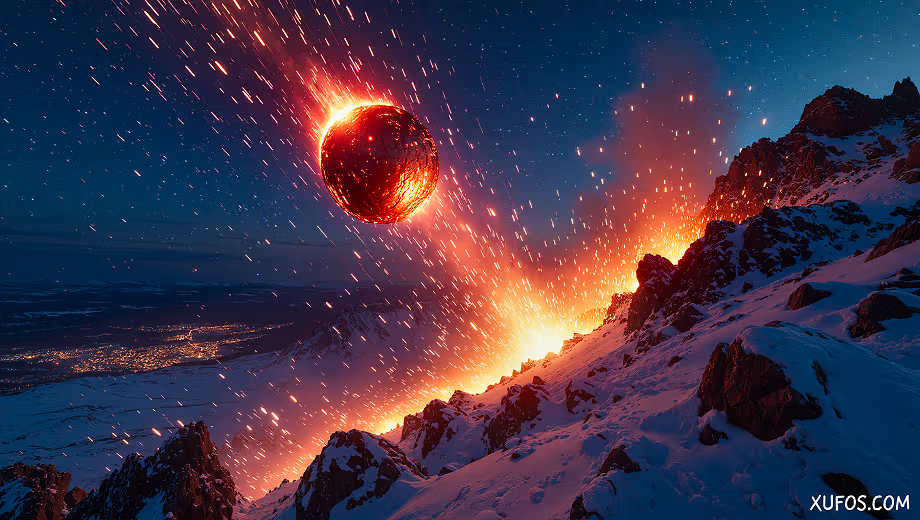
On the cold evening of January 29, 1986, in the remote mining town of Dalnegorsk, Primorsky Krai, Soviet Union, more than twenty residents watched a glowing reddish-orange sphere, about 3 meters across, fly silently parallel to the ground. It suddenly jerked, then fell like a rock onto Height 611 (Izvestkovaya Mountain), crashing with a dull thump and burning intensely for an hour. No explosion, just flames.
Two days later, ufologist Valery Dvuzhilny led a team to the site, finding a 2x2 meter scorched area with unusual debris: lead-iron alloy droplets, vitreous black particles, quartz-like mesh nets, and scaly fragments. Lab analysis revealed bizarre properties: amorphous alloys with rare elements, extreme hardness, and structures impossible with 1980s tech.
Timeline of Events – January 1986 & Aftermath
Reconstructed from eyewitness reports, Valery Dvuzhilny's investigation, Soviet lab analyses, and later publications. The incident sparked ongoing UFO activity in the area.
- January 29, 1986, around 19:55 local time Multiple witnesses (locals, miners, schoolboy Yevgeny Serebrov, newspaper editor V. Korotko) see a reddish sphere, size of half the moon from distance, flying low and silent from southeast. Object glows like burnished stainless steel, moves parallel to ground at an estimated 15 m/s, then jerks violently and plunges at 60-70 degree angle onto Height 611. Dull impact thump heard, object burns brightly for about an hour. No tail like meteor, no sound during flight or crash.
- January 30–February 2 Snow-covered crash site untouched. Locals avoid due to remoteness and cold, but rumors spread. No immediate official response.
- February 3–6, 1986 Valery Dvuzhilny (teacher and head of Far Eastern Commission on Anomalous Phenomena) leads expedition to Height 611. Team finds sharply defined 2x2 meter area free of snow despite deep surroundings, rocks vitrified/smoky from extreme heat, tree stump turned to porous coal. Debris includes silvery metal droplets (30 grams total), black vitreous particles, loose scaly "nets" or mesh embedded in rocks, lead balls, iron fragments. Magnetic anomalies noted.
- February–March 1986 Samples sent to labs in Vladivostok, Tomsk, Novosibirsk, Moscow. Analyses show lead alloy with up to 17 elements (including rare earths, tungsten, molybdenum), amorphous "metallic glass" structure, extreme hardness (diamond saw needed to cut larger pieces), unusual isotopic ratios suggesting terrestrial lead but anomalous composition. "Quartz mesh" particles defy easy explanation, fine, net-like, high-temperature formed.
- November 28, 1987 Major UFO flap over Dalnegorsk: 33 objects sighted, 13 fly directly over town/Height 611. Witnesses report cylinders, cigars, globes. Electromagnetic interference corrupts files. Dvuzhilny suggests possible "rescue" or follow-up activity at crash site.
- 1990s–2000s Dvuzhilny publishes findings, shares with international ufologists. Case gains "Russian Roswell" nickname. No official Soviet/Russian government admission.
- 2020s onward Renewed interest via documentaries, podcasts, and UAP disclosure discussions. Physical samples remain enigmatic; some claim nanotechnology-like lattices ahead of era.
What Witnesses and Investigators Described
The object was a near-perfect reddish-orange sphere, about 3 meters diameter, glowing intensely without sound or trail. Flight steady then sudden jerk, controlled or uncontrolled fall, crash into rocky slope. Impact left no crater, just defined burn zone. Dvuzhilny's team found high-temperature traces: scorched rocks, melted silica, burnt vegetation sharply bordered. Debris unusual: small metallic droplets (lead-iron base with rare elements), larger hard compounds, black glass-like particles, "quartz nets" or mesh (fine interwoven structures).
Witnesses (locals, schoolboy) described the flight path as deliberate until failure. No beings or bodies were reported at the scene, so the focus was on the craft and aftermath. Dvuzhilny concluded artificial probe of possible non-terrestrial origin based on materials defying 1980s manufacturing.
"The sphere flew silently, then jerked and fell like a rock. The crash site burned for an hour. We found strange droplets and mesh in the rocks that labs could not fully explain."
– Valery Dvuzhilny, lead investigator
Analysis showed amorphous alloys, extreme hardness, and element substitutions after vacuum melting (gold/silver vanished, titanium/molybdenum appeared). Fascinating puzzle that keeps researchers hooked.
Key Documentaries on Dalnegorsk Height 611 Incident

More videos on Dalnegorsk Height 611 UFO on YouTube
The Official Response & Investigation
Soviet authorities did not publicly comment at the time. No military recovery reported; site open to researchers. Dvuzhilny's independent team collected samples, shared with labs. Results enigmatic: no conventional explanation fit. Some suggested meteor or secret test, but alloys and structures mismatched. KGB suspicions arose among enthusiasts. In post-Soviet era, case remains unexplained. Physical evidence (droplets, mesh) held privately or in labs, fueling speculation of cover-up or genuine anomaly.
Legacy in 2026
Forty years on, Dalnegorsk Height 611 endures as one of Russia's most intriguing cases. Physical debris, lab anomalies, and witness consistency set it apart. Dvuzhilny's work showed something extraordinary happened on that snowy hill. The 1987 flap adds layers, perhaps follow-up or response. In 2026, with UAP transparency growing, this feels like a window into something bigger: advanced tech crashing near a mining town, leaving traces that still puzzle scientists. The hope is disclosure will revisit these materials, revealing what flew silently that winter night and why it matters today.
