Quick Info
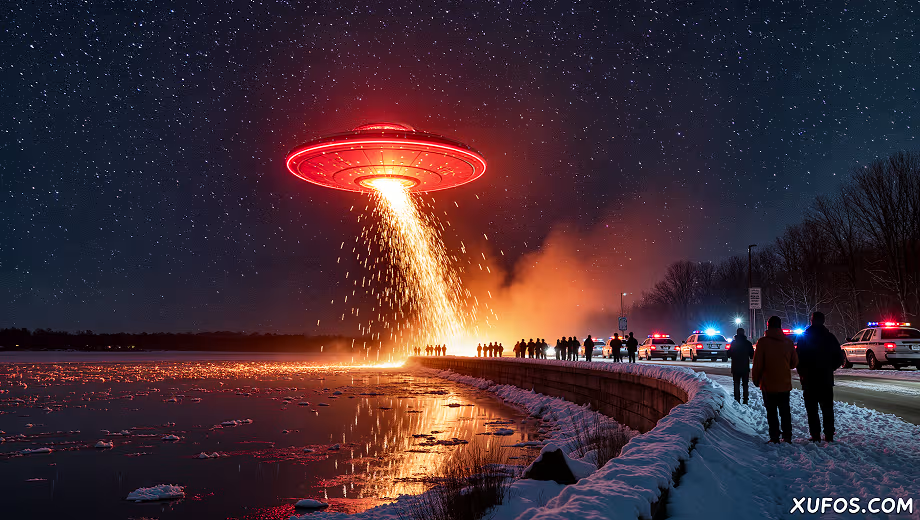
On the evening of December 17, 1977, multiple independent witnesses in Council Bluffs, Iowa watched a reddish luminous object descend into Big Lake Park. It left behind a large glowing mass of molten metal that ignited the grass and remained extremely hot for hours. Police and firefighters arrived within minutes and recovered approximately 35–55 pounds of unusual slag. One of the strongest physical-evidence UFO cases in the American Midwest.
Eleven witnesses, including police and fire personnel, gave consistent accounts. The material was analyzed multiple times and later studied with modern techniques by researchers including Jacques Vallée and Garry Nolan. No conventional explanation has ever fully accounted for the event.
A Normal Saturday Evening in Big Lake Park
December 17, 1977 was a cold Saturday night in Council Bluffs, Iowa. Big Lake Park was a popular local spot, but on this particular evening it became the scene of one of the strangest events in Iowa history.
The Object Appears
At approximately 7:45 PM, three teenagers driving on North 16th Street noticed a reddish object about 500–600 feet in the air, falling straight down. It disappeared behind the trees of Big Lake Park, followed by a brilliant bluish-white flash and two large plumes of fire shooting more than ten feet into the air.
Multiple Independent Witnesses
The teenagers drove into the park to investigate and found a glowing orange blob on a dike near the road. At the same time, other witnesses including Criss Moore and his wife, and a couple named Kenny and Carol Drake, saw the same event from different locations. Some described a round object hovering with red blinking lights before it fell.
“We saw this big ball of red stuff in the sky… it dropped something into the park. Something on fire.”
- Criss Moore
In total, at least eleven independent witnesses reported the same sequence of events.
The Glowing Molten Mass
When the witnesses reached the spot, they found a 4-by-6-foot area covered in glowing orange molten metal. The material was so hot it ignited a small grass fire and continued to boil and run down the side of the dike. The center remained warm to the touch for nearly two hours. Assistant Fire Chief Jack Moore described it as “some kind of metal” that “you can’t break it and you can’t bend it.”
Police and Fire Department Response
The fire department arrived within fifteen minutes, followed quickly by police. They photographed the scene, collected samples of the still-molten material, and took statements from all witnesses. The rapid official response and the presence of both fire and police gave the case immediate credibility.
Physical Evidence and Laboratory Analysis
When police and firefighters reached the site they found a large glowing mass of material spread across the dike. Estimates put the total weight between 35 and 55 pounds. The substance was still bright orange and molten in places, hot enough to ignite the dry grass around it. Assistant Fire Chief Jack Moore later said the center of the mass remained too hot to touch for nearly two hours. The material had a glassy slag-like appearance on top with metallic lumps underneath and some white ash mixed in.
“It was glowing red-orange and you could see it boiling. It was definitely some kind of metal. You couldn’t break it and you couldn’t bend it.”
- Assistant Fire Chief Jack Moore
Samples were collected that same night and sent for analysis to Iowa State University and several local metallurgical labs. Early tests showed the material was primarily high-carbon steel slag containing small percentages of nickel, chromium, magnesium, silicon, and titanium. The microstructure indicated the metal had been heated to roughly 1000°C and then cooled at an intermediate rate, something not consistent with ordinary industrial waste or a simple furnace spill.
Investigators quickly ruled out a meteorite because there was no impact crater and the material did not match known meteoritic composition. Aircraft debris and common industrial slag were also eliminated due to the unusual purity and the way the material had been deposited. No local factories or rail lines reported any missing material or accidents that night.
The 2022 Scientific Re-examination
In 2022 a team including Garry Nolan and Jacques Vallée performed advanced isotopic analysis on a preserved sample. Their study confirmed the material was mostly terrestrial in its isotopic ratios but showed some interesting anomalies, particularly in the iron isotopes (notably elevated 57Fe).
The sample was unusually homogeneous for a random industrial byproduct and did not perfectly match any known manufacturing process from 1977. While not conclusive proof of anything extraterrestrial, the results left the case open as genuinely unexplained.
The physical evidence remains one of the strongest aspects of the Council Bluffs incident because it was collected within minutes by official personnel, photographed on scene, and subjected to both 1970s and modern laboratory scrutiny.
Timeline of the Council Bluffs Incident
- Around 7:45PM on December 17, 1977 – Reddish object observed falling by multiple witnesses.
- Impact – Bluish-white flash and flames erupt in Big Lake Park.
- Within minutes – Witnesses reach the glowing molten mass.
- Within 15 minutes – Police and fire department arrive and begin investigation.
- Following days – Samples collected and analyzed by Iowa State University.
- 2022 – Advanced isotopic study by Dr Garry Nolan, Jacques Vallée and colleagues.
Why This Case Still Matters
The Council Bluffs incident stands out because of the combination of multiple independent witnesses, immediate official response, and tangible physical evidence that was collected and analyzed. The material was not just “lights in the sky”, it was something solid, extremely hot, and chemically unusual that remained on the ground for investigators to study. Even modern scientific analysis has not provided a fully satisfactory conventional explanation.
Great video on this event from @PodcastUFO on YouTube

More videos from @PodcastUFO on YouTube
What Do You Think?
After reading about the multiple witnesses, the glowing molten metal, and the scientific analysis of the Council Bluffs incident, what’s your reaction? Do you think this was something truly unexplained, or could there be a conventional explanation that fits all the evidence? Why do you think an object would drop a large amount of hot metal in a public park? I think when someone like Dr. Garry Nolan tells you the metal was indeed weird it is very much worth listening to him. Today in 2026 it's almost 48 years later and this remains one of Iowa’s most intriguing physical evidence cases, I’d love to hear your thoughts on this event.
