Quick Info
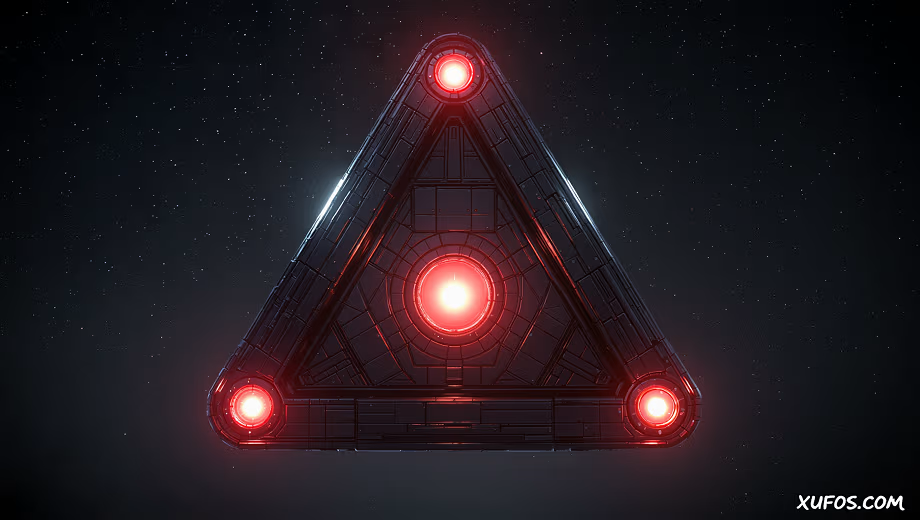
Late November 1989 through April 1990. Belgium became the epicenter of one of the most extraordinary and well-documented UFO phenomena in modern history. Thousands of witnesses, including dozens of police officers, described large, silent, low-flying triangular craft equipped with bright white lights at each corner and often a pulsing red or orange beacon in the center. The objects hovered motionless, moved slowly at first, then accelerated abruptly without sound or visible propulsion. Reports spanned Wallonia, Brussels, and Flanders.
The Build-Up: First Sightings in Late 1989
The Belgian UFO wave began quietly on November 29, 1989, near Eupen in eastern Belgium, close to the German border. Two gendarmerie (police) officers on patrol spotted a massive triangular object hovering silently above the tree line. They described it as flat and triangular, roughly the size of a football field, with three intense white lights at the corners and a brighter red light in the center that pulsed or rotated. The craft made no sound and cast a beam downward, illuminating the ground like searchlights. The officers watched it hover for several minutes before it tilted and moved away slowly, then accelerated out of sight.
Over the following weeks and into December 1989 and January 1990, similar reports trickled in from the Walloon region and around Liège. Witnesses included civilians, farmers, and more police. Descriptions stayed remarkably consistent: equilateral or isosceles triangle, black or dark hull blending into night sky, no fuselage or wings, silent operation even at low altitude, and the signature lighting pattern. Some reported the objects descending to treetop level or hovering over fields and highways before departing vertically or horizontally at high speed.
"It was enormous, silent, and right above us. The lights were so bright they hurt your eyes, but no engine noise at all."
– Gendarmerie officers near Eupen, November 29, 1989
The wave peaked dramatically on the night of March 30–31, 1990, when multiple radars (military and civilian) tracked unidentified targets, leading the Belgian Air Force to scramble two F-16 fighters for intercept. Pilots achieved radar locks showing extreme performance: accelerations from 150 to over 1,100 mph in seconds, altitude shifts of thousands of feet instantly, and maneuvers impossible for conventional aircraft. No visual contact by pilots, no sonic booms, yet ground witnesses and radar corroborated the events. The official Belgian Air Force report, released publicly, admitted the phenomena remained unexplained.
By early 1990, the Belgian Society for the Study of Space Phenomena (SOBEPS), a respected civilian UFO research group, began systematically collecting testimonies. They documented over 650 high-quality cases from more than 2,000 total reports, filtering out obvious misidentifications.
The Peak: March 30–31, 1990 – Radar, F-16s, and Mass Witnesses
The wave reached its climax on the night of March 30 into 31, 1990. Starting around 10:50 p.m., gendarmes in the Wavre/Brussels area reported three unusual lights forming an equilateral triangle moving slowly and silently. Multiple police stations received calls. Ground witnesses estimated the object at 100–150 feet across, low-flying (500–2,000 feet), and completely quiet.
At 23:00–23:30, the Glons Control Reporting Center (CRC) and Semmerzake Traffic Control radar independently detected an unidentified target matching witness locations. The object showed erratic behavior: rapid altitude changes and speed bursts. At 00:05, the Belgian Air Force authorized scramble of two F-16s from Beauvechain Air Base.
The pilots, airborne by 00:05–00:15, achieved radar locks multiple times over the next hour (nine intercept attempts total). Key data from onboard AN/APG-66 radars and ground stations:
- First lock (00:13): Target at ~150 knots (~173 mph), 9,000 ft. Abrupt acceleration to 970 knots (~1,117 mph) in seconds; descent from 9,000 to 5,000 ft, then climb to 11,000 ft, drop near ground level. Lock broken.
- Subsequent locks: Similar patterns of sudden velocity jumps (e.g., 100 to 600+ knots), altitude swings of 4,000–6,000 ft in under 5 seconds, equivalent to accelerations of 40–100+ g (lethal to humans).
- No sonic boom despite supersonic speeds; no visual acquisition by pilots despite clear night and proximity.
Post-flight, Major General Wilfried De Brouwer (Chief of Operations) confirmed in official statements and press conferences that the performance exceeded known technology, no conventional aircraft (including classified ones) could match it without visible propulsion or sonic effects.
"The Belgian UFO wave was exceptional and the Air Force could not identify the nature, origin and intentions of the reported phenomena."
– Maj. Gen. Wilfried De Brouwer, Belgian Air Force (official report and later interviews)
Over the next two weeks, 143 additional witnesses (after media coverage) reported seeing the same object that night, pushing total credible reports higher.
Witness Profiles and Consistency
What elevated this wave: diversity and reliability of observers. Over 19 police officers filed official reports. Air traffic controllers, civilians in groups, and even military personnel on ground corroborated. No profit motive; many reluctant to speak publicly due to ridicule fears. SOBEPS interviews emphasized consistency in shape (triangular, 30–150 m side), silence, low speed then burst acceleration, and lighting (three white corners, central red/orange pulsing).
The SOBEPS Investigation: Methodology, Analysis, and Conclusions
The Société Belge d'Étude des Phénomènes Spatiaux (SOBEPS), founded in 1971 as a scientific-oriented UFO research organization, played the central role in documenting the wave. Unlike sensationalist groups, SOBEPS emphasized empirical methods: these included on-site field investigations, standardized witness questionnaires, cross-verification of witness testimonies, photographic and radar analysis, and collaboration with physicists, astronomers, and engineers. They published two comprehensive volumes: *Vague d'OVNI sur la Belgique – Un Dossier Exceptionnel* (1991) and *Vague d'OVNI sur la Belgique 2 – Une Énigme Non Résolue* (1994), totaling hundreds of pages with raw data, maps, timelines, and expert contributions.
Methodology highlights: SOBEPS received over 2,000 notifications (phone calls, letters, media clippings) and prioritized 650+ "high-quality" cases for full investigation. Investigators (trained volunteers) conducted in-person interviews within days, often at sighting locations to assess terrain, visibility, and potential misidentification sources (e.g., planes from nearby airports, stars, or lighthouses). They used triangulation for distance/size estimates, collected corroborating reports from independent witnesses, and analyzed any photos/videos (though most were low-quality; the famous Petit-Rechain triangle photo was later debunked as a hoax in 2011, but SOBEPS had already flagged doubts due to lack of context/exif data).
Key analyses included atmospheric optics by Prof. Auguste Meessen (Catholic University of Louvain physicist), who ruled out common mirages (Fata Morgana) for low-altitude, dynamic objects. Radar/photo correlations showed no match with conventional aircraft or satellites. Statistical breakdown: ~70% of investigated cases remained unexplained (Pan-D in GEIPAN-like classification), with ~50% having documentary evidence (photos/camcorder). Witnesses were diverse (police, teachers, farmers, military), reducing hoax/delusion likelihood. SOBEPS concluded the core phenomenon was genuine and anomalous: silent, massive triangles with impossible flight (hover to hypersonic without boom, extreme g-forces), not attributable to known tech (no classified stealth matched silence/low-speed capability), natural phenomena, or mass hysteria. They avoided ET claims but stressed "unidentified aerial phenomena" requiring further scientific study.
"The Belgian UFO wave was exceptional... We collected consistent data pointing to a real, unexplained phenomenon beyond current technology."
– SOBEPS researchers (summary from Vague d'OVNI Vols. 1 & 2)
Critics (e.g., Marc Hallet's 1992 essay) accused SOBEPS of media amplification leading to social contagion, but the group's early fieldwork (pre-peak media) and multi-sensor cases countered this. Even after the 2011 photo hoax, COBEPS (SOBEPS successor) and Patrick Ferryn reaffirmed the wave's core validity, citing police/radar evidence unaffected by fakes.
The Official Belgian Air Force Report and Aftermath
In summer 1990, the Belgian Air Force released a detailed public report (unusual transparency). It included radar plots, F-16 data tapes, witness summaries, and conclusion: phenomena real, performance anomalous, no identification possible. NATO radars reportedly corroborated some tracks. No evidence of hoax or foreign intrusion (e.g., stealth aircraft like F-117 tested elsewhere, but not matching behavior).
Skeptical Explanations and Counterpoints
Skeptics propose mass delusion amplified by media (Philip J. Klass-style social contagion), misidentified helicopters (noise masked by wind/car engines), or atmospheric effects (temperature inversions creating mirages of stars/planes). One famous photo (triangular craft) admitted hoax in 2011 (styrofoam model). Some analysts suggest multiple mundane causes: ultralights, balloons, satellites in formation.
However, critics of debunking note radar locks from independent sources, extreme g-forces incompatible with manned craft, silence at low altitude, and lack of sonic booms. Mass hysteria fails to explain multi-sensor data and trained observers.
Great Belgium UFO Wave video from Red Web

Legacy in 2026
Thirty-six years later, the Belgian wave stands as a benchmark for credible UAP cases: mass witnesses, military involvement, radar corroboration, official transparency. It influenced European UFO research and parallels modern U.S. Navy incidents (multi-sensor, physics-defying). Amid AARO reports and congressional hearings, it reminds us some phenomena resist easy explanation. Was it secret tech, natural anomaly, or something else? The Belgian government closed the file unexplained.
